How to Launch a Company Video on YouTube (Without Your Coworkers Sinking It)
Launch a company video on YouTube to its real audience first (customers, target accounts and the people your buyers follow) for 48 to 72 hours, and send the all-hands email on day four. Your coworkers click out of loyalty, not interest, so their views tell you (and possibly YouTube) nothing about who the video is for.
The all-hands email that quietly sinks your video
It's 9:02 on launch day. The brand film went live at 9:00. Comms hits send on the company-wide email: "Our new film is LIVE! Go watch, like and share!"
By 9:15 the Slack channel is a wall of clapping emoji. The CEO replies-all with "Proud of this team." Somebody's mom leaves a comment.
By lunch the video has 900 views. Most of them stopped around the 40-second mark, right after the viewer spotted Dave from finance in the warehouse shot.
By Friday it has 1,100 views. A month later, 1,140.
Then comes the meeting where someone says the line every video team dreads: "I guess YouTube just doesn't work for B2B."
Congratulations. You've launched a video to the people who made it.
So what? The film wasn't the problem. The launch order was. Your own people are the worst first audience a new video can have, and almost every company sends them in first.

Why your coworkers are the wrong first audience
Employees watch out of loyalty, not need. That's lovely for morale and useless as a signal.
Think about who actually clicked that all-hands link. People who already know the product. People who were on set. People who will watch 40 seconds to be supportive, then get back to their inbox.
None of them is the plant manager the film was made for. And the first wave of viewers is exactly when you most need to learn who the video works for.
Three things go wrong when they arrive first:
- Your numbers stop meaning anything. You can't tell whether the title and thumbnail work when a third of the clicks came because the CEO asked.
- Your targeted push gets drowned out. A rep's note to a key account lands in the same week as 800 polite internal views, and you can't separate one from the other.
- You may be teaching YouTube the wrong lesson. More on that "may" in a second, because it matters.
What YouTube actually says (and where we're placing a bet)
YouTube says outside traffic shouldn't hurt. We still put employees last, and the reasons hold up even if YouTube is completely right.
YouTube describes recommendations as a pull, not a push. Your Home feed is built mainly from your own watch history, and a video earns its way into more feeds by satisfying the people who see it, measured through signals like clicks, watch time, likes, shares and survey responses.
Here's the part most launch advice skips. Todd Beaupré, who leads discovery at YouTube, has said that Home and Suggested learn mainly from how a video performs on those surfaces, "so external traffic shouldn't hurt."
That's a first-party statement, and we take it seriously. We also read thousands of threads where marketers trade notes on what they've actually tested, and their reports are more specific: off-target outside traffic seems to drag a new video down, and relevant outside traffic seems to help.
So we're not going to dress this up. "Employees last" is a reasoned bet, not a published YouTube rule. Here's why we'd make it anyway:
- If YouTube is right, 400 employee views cost you nothing in reach. They still cost you three days of clean data.
- If the practitioners are right, those views tie your video to the wrong crowd at the exact moment the system is figuring out who it's for.
- Either way, buyers-first is free. You aren't skipping your coworkers. You're moving them to day four.
A bet with no downside and a possible upside is the easiest call you'll make all quarter.
The 72-hour launch plan
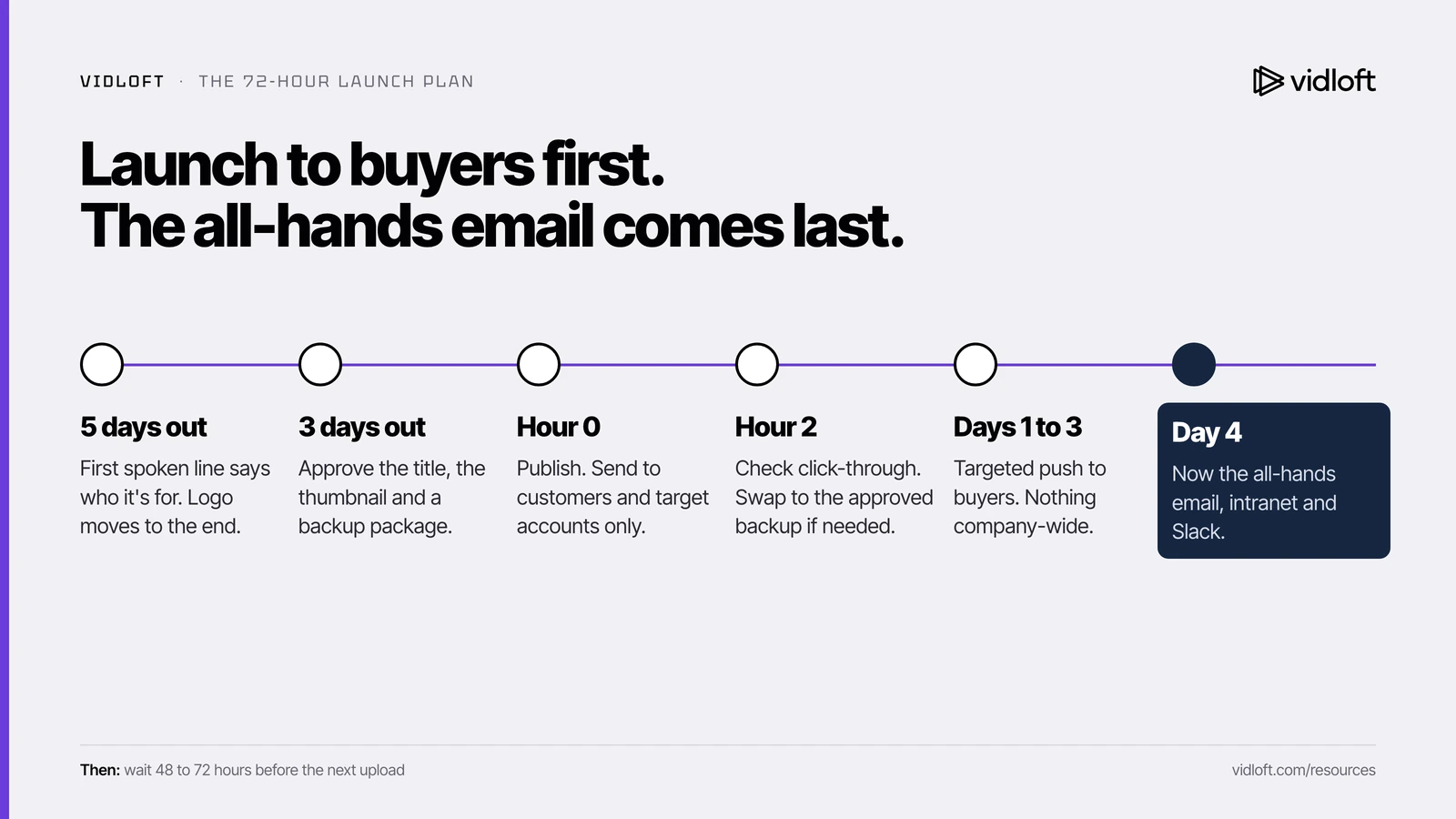
Get approvals done before launch, aim the first three days at the real audience, and let the company in on day four.
| When | What to do | Owner |
|---|---|---|
| 5 days out | Lock the first spoken line and move the logo to the end. Here's how to write that line. | Producer |
| 3 days out | Approve a backup title and thumbnail now, while brand review has time. The backup plan covers what to approve. | Marketing and brand |
| 1 day out | Build the first-wave list (below). Draft every post and email. Send nothing. | Marketing and sales |
| Hour 0 | Publish as a regular upload. Send to the first-wave list only. Reps send one-to-one notes. | Marketing |
| Hour 2 | Check click-through. If it's weak, swap in the pre-approved backup. | Marketing |
| Days 1 to 3 | Targeted push to buyers. Nothing company-wide. | Marketing and sales |
| Day 4 | Internal push: all-hands email, intranet, Slack, with a specific ask. | Comms |
| After | Give this video its own runway before the next one. How far apart to space uploads. | Producer |
Paste it into the launch brief. The two rows that carry this post's idea are below.
Days 1 to 3: who counts as "buyers first"
The first wave is anyone the video was made for, plus anyone those people already follow.
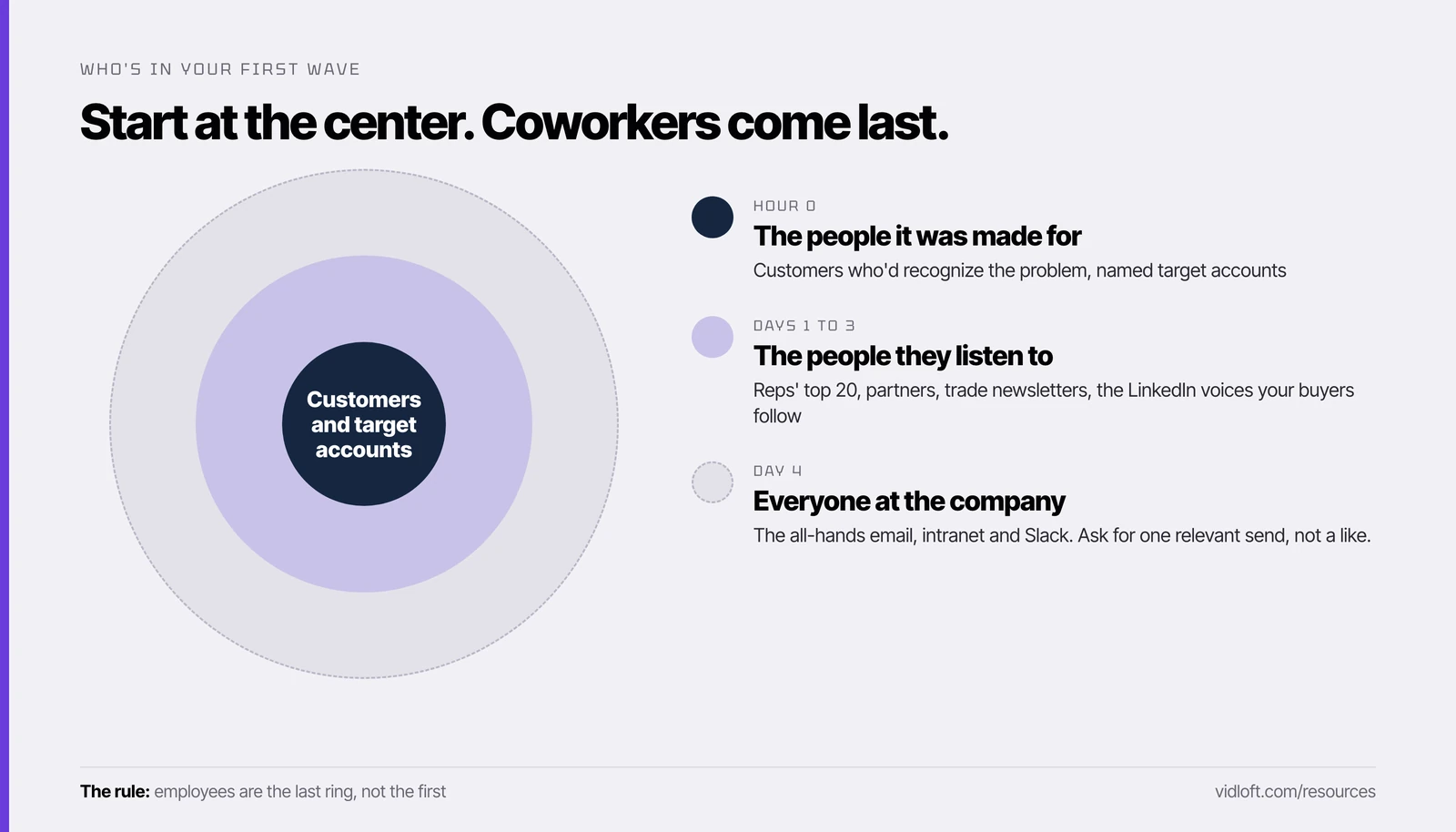
Build the list the day before launch. A good one looks like this:
- Customer contacts who would recognize the problem in the video.
- Named target accounts, sent by the rep who owns each one, as a personal note rather than a blast.
- Each rep's top 20. One line on why this video is relevant to that person beats any template.
- LinkedIn posts from the people your buyers follow. That might be your CEO, a sales leader or the plant manager who actually posts.
- A small paid boost aimed at the job titles the video is for.
- Partner and trade newsletters your buyers already read.
Notice the exception hiding in there. Some employees belong in the first wave. The test isn't their badge. It's who follows them. Your head of sales with 6,000 operations leaders in their network is first wave. The 300 people on the company Slack are not.
Day 4: let the company in (and give them a real job)
Employees make a great second wave when you ask for one relevant send instead of a like.
By day four, the first wave has done its job. You know whether the title is working, which audiences watched longest, and whether you needed the backup. Now your coworkers amplify a video whose packaging is settled.
Don't waste it on "go watch, like and share." Here's an all-hands email you can steal:
Subject: Our new film is out. One favor.
Last week we shared [title] with customers and the accounts we're working with. Now it's your turn. Please don't just watch it. Think of one customer, partner or candidate who should see it, and send it to them with a line about why. If you post on LinkedIn, here's a line written for your network: [line]. Link: [link]
Three things make that email work:
- One person, not "share widely." A single relevant send does more for the video than ten polite views.
- A ready-made LinkedIn line, written for their network, not yours.
- For recruiting videos, go to hiring managers and recruiters first. They know exactly who should see it, which makes them first wave, not day four.
One founder reported that sharing a launch with a small online community of the right people got him about 800 views, against his usual 200. That's one person's report, not a benchmark. But it's the whole idea in one number: the right 50 people beat the wrong 500.
The Vidloft take
Most corporate videos don't die in the edit. They die in the launch email. The team spends eight weeks on the film and eight minutes on the release plan, then decides YouTube doesn't work for B2B.
It works fine. It just needs to meet the right viewers first.
Buyers first. Coworkers on day four.
Frequently asked questions
Should we ask employees to watch our new company video on YouTube?
Yes, on day four, after customers and target accounts have had the first 48 to 72 hours. Employee views don't show who the video is for, and they muddy the early numbers you use to judge it.
Does employee traffic hurt a new YouTube video?
YouTube's head of discovery has said external traffic shouldn't hurt, because Home and Suggested learn mainly from their own traffic. Practitioners report that off-target traffic can drag a video down, so treat employees-last as a reasoned bet that costs you nothing.
Who should see a corporate video first?
The people it was made for: customer contacts, named target accounts reached through one-to-one notes from reps, LinkedIn posts from people your buyers follow, a small paid boost aimed at the right job titles, and trade newsletters.
What should the all-hands email ask employees to do?
Ask each person to send the video to one customer, partner or candidate who should see it, with a line about why, and give LinkedIn sharers a ready-made line written for their network.
Does this apply to recruiting videos?
Yes, but the first wave changes. Hiring managers and recruiters know exactly who should see a recruiting video, so they go out on day one, and the rest of the company follows on day four.
Stop Editing.
Start Scaling.
Your content backlog is a goldmine.
Let us help you mine it.